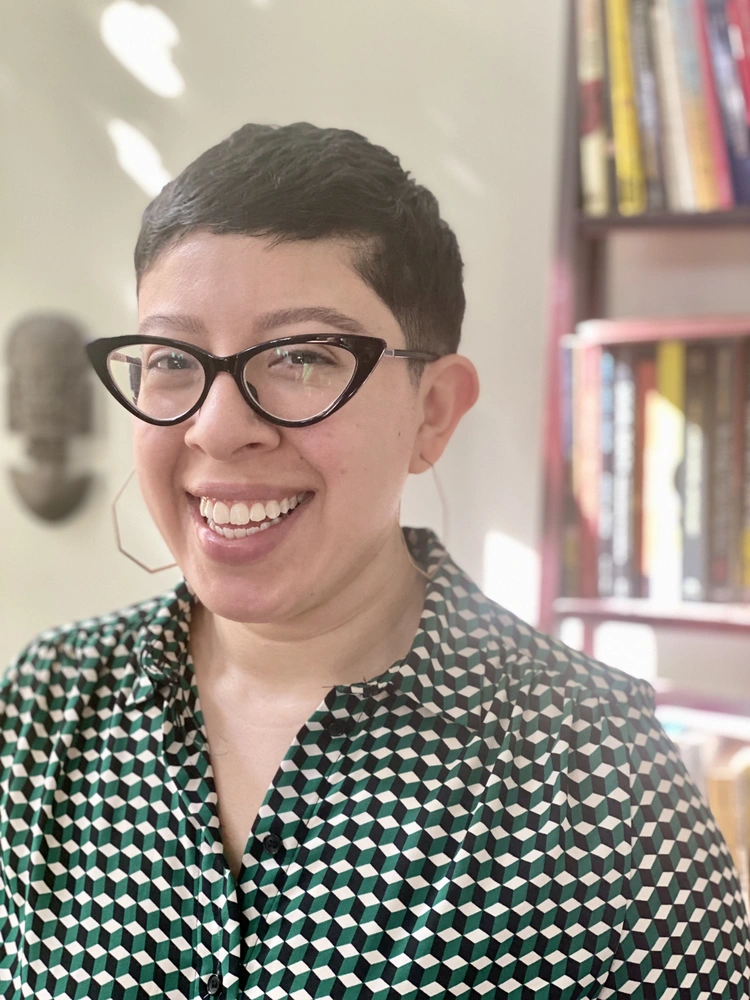
Meet C. Lucio (BA, '17, Latina/Latino studies and anthropology), the executive assistant to the general superintendent for participatory budgeting at the Chicago Park District. They earned a master's degree in urban planning and policy from the University of Illinois Chicago.
For Lucio, their undergraduate degrees are the foundation of their community-centered approach to participatory budgeting. They said LLS and anthropology provided them with a critical lens and historical context to understand how power, race, and equity shape urban planning.
Read on for a Q&A to learn more about their career.
Why did you decide to pursue a degree in Latina/Latino Studies?
I chose to pursue a degree in Latina/Latino studies because I wanted the opportunity to study my own community within a predominantly white institution like the University of Illinois at Urbana-Champaign. It felt empowering to see our histories, struggles, and contributions treated as serious academic inquiry. I also valued being in classrooms where I was surrounded by people who shared similar lived experiences. The small class sizes created space for meaningful dialogue, mentorship, and a sense of belonging that shaped my undergraduate experience in powerful ways.
Did you double major or minor in any other fields while attending the U of I? How do you think the second major or minor complemented your LLS degree?
In addition to LLS, I majored in anthropology. The two disciplines complemented each other deeply. While LLS grounded me in the historical, political, and cultural experiences of Latine communities, anthropology gave me methodological tools to study migration, power, and systems more broadly. I focused on migrant deaths at the U.S.–Mexico border, and the interdisciplinary training allowed me to approach the topic with both critical theory and ethnographic perspective. Together, the majors strengthened my ability to analyze structural violence while centering human experience.
Did you pursue higher education after undergrad?
Yes, I went on to pursue a Master’s degree in urban planning. Although urban planning may seem very different from LLS, my undergraduate training profoundly shaped how I approach the field. LLS gave me a critical lens through which to understand planning—not as a neutral technical practice, but as something deeply connected to power, race, and equity. It taught me to ask: Who is this plan for? Who benefits? Who is left out?
LLS also provided the historical context necessary to understand how policies have shaped communities over generations. That perspective pushed me to think about planning with, not just for, vulnerable populations, and to prioritize community voice in decision-making processes.
What is your current career and what was your path to that position? How does a degree in LLS inform your work?
I currently serve as the executive assistant to the general superintendent for participatory budgeting at the Chicago Park District. My path to this position was rooted in my interests in equity, community engagement, and public decision-making—interests that were nurtured in LLS.
My degree informs my work every day. Participatory budgeting is fundamentally about sharing power and ensuring that communities—especially those historically excluded from decision-making—have a direct say in how public funds are spent. LLS trained me to think critically about representation, access, and structural inequities. It reminds me that authentic community engagement requires intentional outreach, language access, and accountability.
How have your experiences with the Department of Latina/Latino Studies and your degree in LLS shaped your worldview?
Through LLS, I learned that the study of Latine communities extends far beyond the United States. I came to understand that struggles for justice are interconnected across borders and movements. The fight for immigrant rights, racial justice, Indigenous sovereignty, labor rights, and gender equity are not isolated—they are deeply intertwined.
This training shaped the way I see the world. I approach issues with a global and intersectional perspective, recognizing how systems of power operate and how solidarity across communities is essential for meaningful change. LLS gave me both the analytical tools and the political consciousness to engage with the world thoughtfully and responsibly.
What advice do you have for students interested in pursuing work in your field?
My biggest piece of advice is to stay grounded in community. If you’re interested in public service, planning, or civic engagement work, technical skills matter—but relationships matter more. Spend time listening. Volunteer. Attend community meetings. Learn how public systems work, but also learn how they have historically failed certain communities.
I also encourage students to build both analytical and interpersonal skills. You need to be able to interpret policy and budgets, but you also need to communicate clearly, build trust, and navigate complex power dynamics. Finally, don’t underestimate the value of interdisciplinary training. My background in Latina/Latino studies and anthropology deeply shapes how I approach planning and public engagement work today.
What does a typical workday look like for you? Also, what is an example of the most interesting aspect of your job?
No two days are exactly the same, which is something I really enjoy. A typical day might include coordinating with internal departments, preparing materials for public meetings, managing communications, and ensuring our participatory budgeting process stays on track. There’s a lot of collaboration, problem-solving, and attention to detail involved.
One of the most interesting aspects of my job is seeing community members engage directly with public decision-making. Watching residents propose ideas, advocate for their neighborhoods, and ultimately see their projects funded is incredibly rewarding. Participatory budgeting transforms public funds into something tangible and community-driven—that process never feels routine.
What is your proudest achievement?
My proudest achievement is being able to work at the intersection of equity and public policy in a way that reflects my values. Helping to implement participatory budgeting in a large public agency and ensuring that historically underrepresented communities have access to the process feels meaningful.
On a personal level, I’m also proud of carving out a career path that connects Latina/Latino studies, anthropology, and urban planning. It wasn’t always a straight line, but it has been intentional—and it reflects my commitment to planning with, not just for, communities.