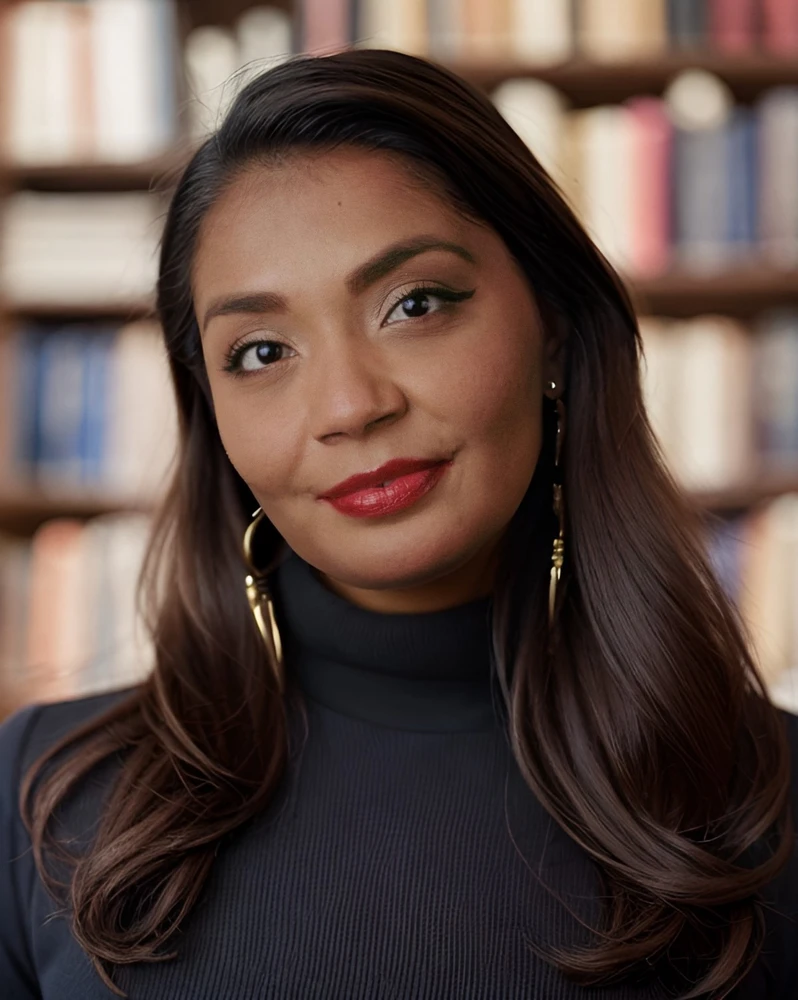
This spring, the Department of Latina/Latino Studies welcomes assistant professor Elena Guzman. Professor Guzman's research studies ritual art and performance in the Afro-Caribbean. She also creates films that focus on the metaphysical and ethereal experiences of African diaspora spirituality. As an artist-scholar, she strives to teach students the power of art and how it can be used for change.
Read on for a Q&A with Guzman to learn more about her research.
What are your research interests and why are you passionate about these areas of study?
My research looks at ritual art and performance in the Afro-Caribbean and the spiritual borderlands created once a ritual is enacted. Art has always been central to Afro-Atlantic religions such as La Regla Ocha, Espiritismo, or Vodou, and serves as a portal for/to the divine. Take the veves drawn on the ground in Haitian Vodou or an intricately designed ritual item for a particular Orisha. Through ritual art, practitioners have the ability to shift time and space. For my work, I am particularly interested in how women and gender queer people use Afro-Atlantic ritual to create black feminist geographies that counter geographies of oppression and instead create landscapes of liberation. By placing Afro-Latin America in a Black Atlantic framework, I address the erasure of Blackness that happens in discourses of Latinidad and foreground lived experiences that counter mestizaje and blanqueamiento.
Why did you decide to join the Department of Latina/Latino Studies at the University of Illinois?
The Department has a rich and ongoing legacy in Latino studies. In fact, it was one of my mentors, Dr. Arlene Torres who was one of the founding faculty of this department. As an undergraduate at Hunter College, it was Dr. Torres work on Blackness in Latin America that inspired the work that I do. To be able to continue that legacy here at the U of I is poetic in many ways. I am excited to be a part of a department looks to center indigeneity and Blackness rather than make it a periphery to the discipline.
Can you tell us about your current research projects?
Chimera Geographies: Spiritual Borderland Performances of the Afro-Caribbean, is an interdisciplinary monograph that explores the way Black women, non-binary, and gender queer people through the Caribbean and its diaspora use spiritual and ritual performance within African Diasporic Religions, to forge interstitial geographies of the Caribbean and African Diaspora, or what I call Black Spiritual Borderlands. These Black queer religious geographies demonstrate how marginalized genders of the African diaspora negotiate and experience place through Black Atlantic ritual and forge spaces of Black queer belonging. With Chimera Geographies, I aim to create a multimedia and transdisciplinary ethnography of diaspora that showcases the varied experiences, expressions, and locations of the African diaspora with a particular focus on Black women, trans, queer, and nonbinary ritual performers. By focusing on how Black queer artists in the Caribbean engage in Black Atlantic spiritual practices, I show how their ritual performances rearticulate capitalist, neoliberal and colonialist notions of time and space by embodying alternative Black Atlantic ethe through their spiritual praxis. I argue that these borderlands spaces forged through spiritual and ritual performance are critical geographies that offer queer and feminist articulations of diaspora.
You’re also a filmmaker. Can you tell us about your past and current film projects?
My film work is central to the research that I do. Film not only offers me an alternative format to engage my research interests, but also allows me to enact the ideas and theories of my research. My first film, Smile4Kime (2023) is a short hybrid documentary that uses animation and live action footage to tell the story of how two friends transcend time, space, and even death to find hope in their struggles with mental health. My second film, Oriki Oshun (2025) is a short experimental film that pays homage to the mother of the sweet waters. Oshun. Weaving different Pataki (sacred stories) of Oshun, the film shows the multiplicity of the Black sacred feminine. I also am co-director for a short film called, Full Set: Portrait of an Artist (2026) that highlights internationally renowned nail artist, Kro Vargas, while also focusing on the aestheticized labor of Black and Latina women.
What classes will you teach?
In the fall semester I will be teaching, Latina/os on the Bronze Screen and a special topics course titled, Visualizing Borderlands. I am excited to teach both of these classes as an artist-scholar and give students the opportunity to not only study art but also create it themselves. As a filmmaker I am especially excited to teach Latina/os on the Bronze Screen, where we will explore how Latina/os have been represented on screen while also focusing on contemporary Latine filmmakers. I get the opportunity to see amazing independent film that rarely reaches most people’s home screens. This will be an exciting opportunity for students to not only learn about mainstream Hollywood Latine representation but also independent filmmakers that are offering beautiful and complex images of Latinidad. The course Visualizing Borderlands will focus on the way borders are maintained, navigated and reimagined. Not only will we focus on geopolitical borders of nation states, but we will also focus on other kinds of borders like redlining, gated communities, and identities. Student will get the chance to see how artists challenge borders and get to make their own art as well!
What key ideas or lessons do you hope to impart to your students?
My courses are designed to show the power of art. I hope my students see art in many forms and the various ways it can be used to create change, and most importantly, I hope to show my students that they can create art that makes a change. A lot of students think art requires technical skills and training, but art can look so many ways and be created in just as many ways. Students will leave my course with practical art making skills all while being grounded in critical theoretical debates and discourses in Latino/a studies. Art is theoretical and art is political.