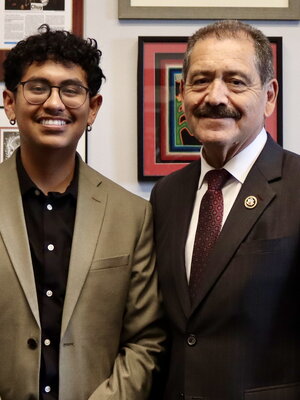
Carlos Hernandez is a Chancellor’s Scholar and double-major in political science and Spanish, while pursuing minors in legal Studies and Latina/Latino studies. During summer 2026, he interned with Illinois Congressman Jesús “Chuy” García through the Congressional Hispanic Caucus Institute (CHCI) Congressional Internship Program. He wrote to us about his experience.
This summer, I had the privilege of serving as a Congressional Legislative Intern for Congressman Jesús “Chuy” García, representing Illinois’s 4th Congressional District. I was placed in this office through the Congressional Hispanic Caucus Institute (CHCI) Congressional Internship Program, which provided me with the opportunity to live and work in Washington, D.C., while gaining firsthand experience in the legislative process.
The Congressional Hispanic Caucus Institute is a nonprofit organization dedicated to developing the next generation of Latino leaders by providing educational, leadership, and professional development opportunities. Through its Congressional Internship Program, CHCI places students in congressional offices where they can gain practical experience in public policy, constituent services, and the day-to-day operations of Congress.
As a “hilltern” in a congressional office I did the typical work of drafting background memos and constituent correspondence for DC staff; summarized legislative developments and tracked bill progress to recommend bill co-sponsorships to the congressman alongside votes in the Judiciary Committee.
As a side passion project I wrote the press release for The Right To Learn Act, managed co-sponsor interest by reaching out to 120 congressmen, and secured endorsements from professors in the College of Education at the University of Illinois.
I learned members of Congress are ordinary people, and if you want to influence legislation, you should contact their staffers, since they are the ones tasked with writing the bills. Getting a bill passed is another story. Through this experience, I improved my ability to give tours and to retain niche facts about the Capitol building. Beyond that, it solidified my desire to pursue a career in public policy.
After wrapping up my congressional internship, through the Obama Foundation Voyager Scholarship, I was given the opportunity to live in Athens for one month and work in an all-boys shelter for the Home Project. The kids taught me some Greek, and I got to see sights like the Acropolis and the Parthenon.
Through the Home Project, I volunteered at the Pugad shelter, where I was assigned to accompany the children to their appointments, including asylum appointments, doctor visits, and shelter visits. Whenever an appointment took a child outside the shelter, I was the person who took them, often on my own.
I spent one entire month alone in Athens without speaking a word of Greek, yet I was able to pull it off. I navigated the public transit and healthcare systems, taking many missteps along the way, but the experience made me feel prepared to handle anything. I accompanied a 12-year-old who spoke only Arabic, while I spoke only English, to a hospital miles away. Using hand signals, nods, and hopeful prayers that someone there spoke English, I got him seen, got the appointment, and scheduled a follow-up. If I can do that multiple times I can truly do anything.
The Congressional Hispanic Caucus Institute (CHCI) offers post-graduation fellowships, so I am considering applying to one in the future. I would love to return to the Hill one day, though I am not sure whether I would come back as a staffer, a lobbyist, or in another role. As for volunteering in Athens, I expect my next visit will most likely be as a tourist, but I would still like to volunteer in more places around the world.
I am currently a Research Assistant to Dr. González Ybarra, in which I transcribe hour-long interviews, conducted in Spanish, with Mayan teachers, which gives me insight into how educators work in communities where students may speak languages other than the country's dominant language. Our primary research goal is to create a database where Mayan teachers can share their teaching materials with one another; no such website or database currently exists. I am also in charge of the other undergraduate research assistants.
By Carlos Hernandez