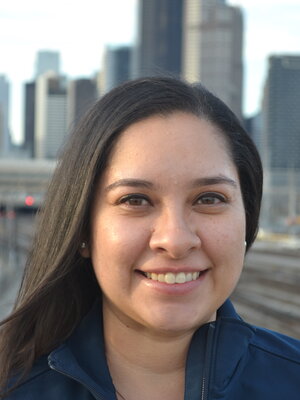
Meet Rosalía Lugo (BS, '10, Community Health, LLS minor; MA, '16, EPOL), an alumni counselor at Pritzker College Prep. For Lugo, her minor in Latina/Latino studies taught her to think critically about how Latina/os fight for representation in predominately white spaces. She uses her training to educate and empower her students to find success while pursuing higher education.
Read on to learn more about her career.
Why did you decide to pursue a minor in Latina/Latino Studies?
From senior year of high school, I wanted to minor in LLS. At the time, it was only offered as a minor and I wanted to major in healthcare. I went to a predominantly white high school, where there were about 10 students who graduated with me that identified as Latina/Latino. I knew that I wanted to learn more about our history and my high school did not fulfill that knowledge.
How did your major in community health complement your minor in Latina/Latino studies?
I majored in Community Health and I knew that our comunidad needed more representation. I felt that my major in Community Health and minor in Latina/Latino Studies combined very well with my career goals. I also worked at McKinley Health Center’s Student Population Health Concerns Committee (Special Pops) and collaborated at La Casa Cultural Latina in creating health programming.
Did you pursue higher education after undergrad?
I attended the U of I’s EPOL masters program. My concentration was Diversity and Equity in Education. At the start of the program, I was working at the Alder Planetarium in the Teen Programs department. My role was to expand the museum exposure to certain communities in Chicago. I worked directly with Little Village Lawndale High School and created Youth Organizations for Lights Out, an environmental justice program that empowered students to advocate about light pollution’s impact. I also managed the summer internship program that hired high school students to work at the museum in the summer. This allowed me to build relationships with organizations, like Enlace Chicago, to recruit students and work at the museum.
What is your current career and how does a degree in LLS inform your work?
I am currently working at Pritzker College Prep as an Alumni Counselor. The school is located in the Hermosa neighborhood, located in the northwest side of Chicago. I work directly with first-gen students who are navigating post-secondary options after graduating high school. Many of the students I work with go off to college, predominantly PWIs, and are the first ones in their families to navigate the college process. As I build meaningful relationships with many of the students, cultura and communicating in English and Spanish, does help with making sure the students feel supported and have a little bit of home when I visit them. Reminding students as to why they chose this path when they start feeling homesick. LLS to me is understanding our cultura and reminding ourselves that we are able to take up space because we do belong.
How have your experiences with the Department of Latina/Latino Studies and your degree in LLS shaped your worldview?
For me, my experience with the Department of LLS started when I began to fully engage with what Latinidad meant to me back in 6th grade. My father was a professor on campus and taught LLS and Anthropology. My mother was a community activist in Champaign-Urbana. At home, we would have many discussions about our community, locally and nationally. In my senior year of high school, my parents allowed me and my sister to skip school to attend the “A Day Without Immigrants” rally on May 1st, 2006. Taking classes with Dr. Lisa Cacho, Dr. Ricky Rodriguez and Dr. Edna Viruell-Fuentes allowed me to think more critically how Latina/Latinos continue to fight for visibility and acknowledgement. I am very intentional when working with students to empower them to and learn that our people have fought for us to be in spaces like museums and university campuses.
What advice do you have for students interested in pursuing work in your field?
There are various aspects of education that does not mean you have to be a teacher and be in the classroom. You can make a difference if you are doing out of school time programming, like at a museum, or providing some form of college counseling empowering students to make choices for their future.
What does a typical workday look like for you? Also, what is an example of the most interesting aspect of your job?
My workday varies depending on the season. Currently, I am traveling to university campuses visiting students and helping them renew their financial aid applications. This is one of my favorite times of the year because students who are in their first year of college are more comfortable with their new schedule, they're finding themselves and are comfortable enough to be open about their college experience.
What is your proudest achievement?
My degrees have allowed me to have a better understanding of the history of marginalized communities and, in a way, find myself being more politically aware. While working at the Adler Planetarium, I collaborated with our telescope team to teach my students about telescopes. We were learning in the Board Room, where the Board of Trustees met. Typically white individuals. My students, from Little Village, were taking up space and learning. That was one of my proudest moments.